
16.10.2025 19:27
Harmanpreet Leads India to Asia Cup Victory and Secures World Cup Spot
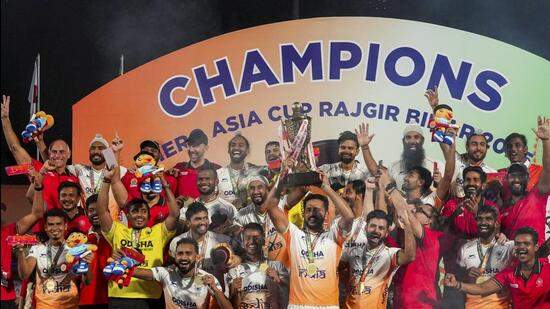
Harmanpreet Singh has long been a reassuring presence for the Indian hockey team, known for his calm demeanor in defense and precision during penalty corners (PCs). As the captain, he remains the team’s trusted leader in challenging situations.
During the final on Sunday, Harmanpreet showcased a new role as a playmaker, orchestrating nearly all the goals for India in their 4-1 triumph over reigning champions South Korea, thus reclaiming the Asia Cup. This victory marked India’s fourth title in the tournament’s history and their first in eight years, securing their qualification for the 2026 World Cup in the Netherlands and Belgium.
Under the guidance of coach Craig Fulton, the team made history by simultaneously holding all three prestigious continental titles: the Asian Games, the Asia Cup, and the Asian Champions Trophy.
South Korea was the only team that had eluded an Indian victory on the blue turf of the Bihar Sports University Hockey Stadium, concluding their previous encounter in the Super 4s with a 2-2 draw. However, in the final, world No.7 India faced no such hurdles.
Mirroring their 7-0 victory against China the day before, Harmanpreet was pivotal in directing the match from the start. Displaying remarkable stick skills, he maneuvered past five South Korean defenders from midfield to inside their circle in the opening minute.
His skillful pass to Sukhjeet Singh (1st minute) allowed the latter to tomahawk the ball past goalkeeper Kim Jae-han, scoring India’s first goal and continuing their momentum from the previous day’s match against China.
Following their strategy from Saturday, Fulton’s team expertly executed high aerial passes, a less common tactic in Asia. Harmanpreet maintained his excellent form, consistently penetrating the circle and earning a penalty stroke, though Jugraj Singh’s shot was skillfully anticipated by Kim, the South Korean goalkeeper.
India kept pressing with strategic long passes, demonstrating high game awareness. Timely substitutions by Fulton ensured fresh players maintained the offensive pressure.
Although the game’s tempo slowed, India retained possession, leading to multiple PCs in their favor.
With his team struggling to capitalize on PCs, Harmanpreet again took charge. He launched an aerial pass from deep defense on the left flank to Sanjay on the right. Sanjay’s quick pass to Dilpreet Singh (28th minute) resulted in India’s second goal just before halftime.
India maintained possession into the second half, but converting chances proved challenging until another skilled pass from Harmanpreet to Raj Kumal Pal led to a setup for Dilpreet (45th minute), who scored India’s third goal just before the third quarter ended.
In the final quarter, the Indian captain, who was the top scorer at the Paris Olympics, contributed to the team’s last goal following a PC. As the Korean defenders rushed towards him, Abhishek deftly passed the ball to Amit Rohidas (50th minute), who struck powerfully to put India ahead 4-0.
Despite South Korea’s attempts to counterattack, midfielder Vivek Sagar Prasad effectively thwarted their offensive moves. Eventually, Korea managed a consolation goal via a PC converted by Son Dain (51st minute). Nonetheless, India maintained their lead and clinched the title, achieving their major objective of securing a World Cup spot.
Coach Fulton remarked, “We are progressing steadily. Hockey in Asia and Europe differs, with the powerhouses in Europe and also Australia. We aim to deepen our squad’s capability to compete with the global teams.”
“Our team possesses exceptional intelligence, and they excel in executing strategies. We thoroughly analyze both the opposition and ourselves, placing a greater focus on self-assessment. When committed, our team delivers remarkable results. Our goal remains to be the top team in Asia, and we are approaching that achievement,” Fulton concluded.